


Please Leave Us A Message

Haoyong Automotive Controls
The AC actuator is usually located on or near the vehicle's HVAC housing behind the dashboard. Depending on the vehicle's make, model, year, trim, and climate-control configuration, you may find the actuator behind the glove box, under the dashboard, near the center console, or behind part of the instrument panel.
Because modern vehicles can use several HVAC Actuators, the exact location depends on which function you are trying to diagnose. A blend Door Actuator, mode actuator, and recirculation Door Actuator may all be installed in different positions.
If you are hearing an AC actuator clicking noise behind the dashboard or the HVAC system is not responding correctly, identifying the actuator's location is an important first step in diagnosis.
An AC actuator is a small electric motor and gear mechanism that moves one of the doors inside a vehicle's HVAC system. These doors control how air travels through the heating and air conditioning housing.
A blend door actuator controls the temperature of the air entering the cabin by changing the position of the blend door. A mode actuator can determine whether air is directed toward the dashboard vents, floor vents, or windshield defroster. A recirculation actuator controls whether the system uses outside air or recirculated cabin air.
Some vehicles have only a few actuators, while vehicles with automatic or dual-zone climate control may use several.
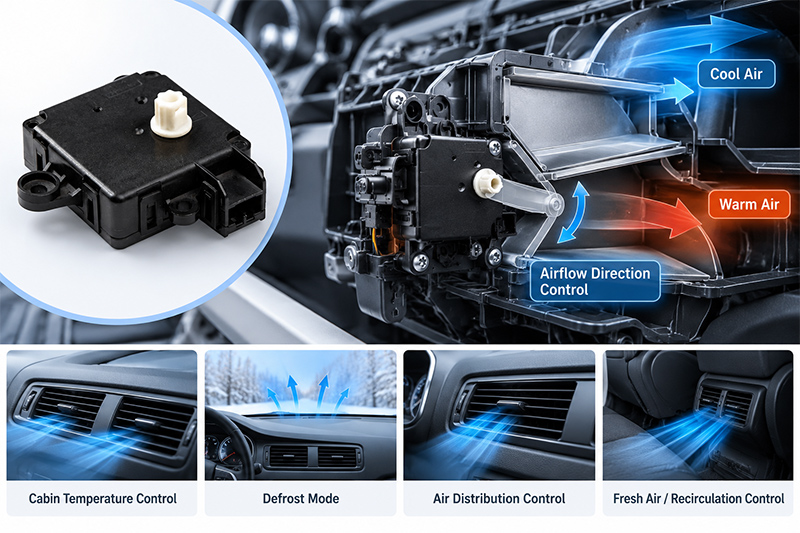
In most vehicles, the AC actuator is attached directly to the HVAC case behind the dashboard. The HVAC case contains components such as the evaporator, heater core, blower-related airflow passages, and internal doors.
The most common locations include the following areas:
Behind the passenger-side glove box
Under the passenger-side dashboard
Near the center console
Behind or below the center dashboard
Near the driver's footwell
Behind sections of the instrument panel
The exact position varies considerably between vehicle designs. Even two vehicles from the same manufacturer can have different actuator locations depending on the HVAC configuration.
One of the most common locations is behind the passenger-side glove box. On some vehicles, removing or lowering the glove box provides access to the HVAC housing and one or more actuators.
You may see a small plastic motor assembly attached to the HVAC case with an electrical connector. The actuator is normally secured with screws or similar fasteners and connects mechanically to an HVAC door.
However, seeing an actuator behind the glove box does not automatically mean it is the failed component. There may be multiple actuators in the same general area.
Some vehicles place the actuator underneath the dashboard, particularly near the passenger footwell or center section of the HVAC housing.
This location can make diagnosis more difficult because visibility may be limited. A technician may need to use a flashlight, inspection mirror, scan tool, or other diagnostic equipment to identify which actuator is responding to a climate-control command.
In some vehicle designs, removing a lower dashboard panel may provide sufficient access. Other designs require considerably more interior disassembly.
If your question specifically concerns the blend door actuator, it is generally mounted to the HVAC housing behind the dashboard. Common positions include behind the glove box, under the dashboard, or around the center console area.
The blend door actuator is responsible for positioning the door that controls the temperature of air entering the cabin. If it fails, the vehicle may produce hot air when cold air is selected, cold air when heat is selected, or inconsistent temperatures between different vents.
In dual-zone climate-control systems, there may be separate left and right blend door actuators. This means a vehicle can have one working temperature zone and another zone with an actuator problem.
Finding the actuator is only part of the diagnosis. You also need to determine which actuator controls the function that is malfunctioning.
For example, if the air temperature does not change when you adjust the temperature setting, a blend door actuator may be involved. If the temperature is correct but air only comes from the floor vents, a mode door actuator may be more relevant.
If outside air continues entering the cabin even when recirculation is selected, the recirculation door actuator may need to be inspected.
| Symptom | Possible Actuator | Area to Inspect |
|---|---|---|
| Air remains hot or cold | Blend door actuator | HVAC housing |
| Airflow stays on one vent position | Mode door actuator | HVAC housing or center dash |
| Recirculation does not work | Recirculation actuator | Air inlet/HVAC area |
| Driver and passenger temperatures differ | Dual-zone blend actuators | Left and right sides of HVAC housing |
An AC actuator clicking noise is one of the more recognizable signs of an actuator or HVAC door problem. The noise often comes from behind the dashboard and may occur when the vehicle is started or when the temperature or airflow setting is changed.
A common cause is damaged or worn internal gears. The small motor attempts to rotate the actuator, but the gears slip instead of moving the HVAC door correctly.
A clicking noise can also occur when the HVAC door itself is stuck. In that situation, the actuator may be trying to perform its job but cannot move the door through its normal range.
Therefore, an AC actuator stuck condition does not always mean that the actuator motor itself is defective. The door, linkage, wiring, calibration, and control system may also need to be checked.
If the AC actuator not working symptom appears, first identify which HVAC function has stopped responding.
Set the HVAC system to a known position and slowly change the temperature or airflow setting. Listen for movement behind the dashboard. If there is no sound or movement, the actuator may have lost electrical power, developed an internal fault, or failed mechanically.
If you hear clicking but the air temperature or airflow does not change, the actuator gears or the HVAC door may be stuck. A scan tool may also be required on vehicles with electronically controlled HVAC systems to check actuator commands or related fault codes.
No. There is no universal AC actuator location.
Vehicle manufacturers package the HVAC housing differently. Some vehicles provide relatively easy access through the glove box, while others place actuators deep behind the dashboard.
Access can also vary between manual and automatic climate-control systems. Dual-zone systems may have additional actuators, which can make the dashboard layout more complicated.
For this reason, the most accurate way to find the correct actuator is to check the vehicle's service manual or repair information using the exact make, model, model year, engine, and HVAC configuration.
Whether you can replace an AC actuator yourself depends on its location and the vehicle's design. Some actuators can be reached after removing the glove box or a lower dashboard panel. Others may require removal of substantial interior trim or parts of the instrument panel.
Care should be taken around electrical connectors, airbags, and other dashboard components. If the actuator is located near an airbag or requires significant dashboard removal, professional service may be the safer option.
After replacement, some vehicles also require actuator calibration or relearning. Installing the correct part without completing the required calibration may result in incorrect temperature control or repeated actuator movement.
A practical approach is to begin with the symptom rather than removing dashboard components immediately.
Identify whether the problem involves temperature, airflow direction, or air recirculation.
Listen for an AC actuator clicking noise when changing the relevant HVAC setting.
Check the service information for the exact vehicle configuration.
Locate the HVAC housing and identify the actuator associated with the affected function.
Inspect the actuator, connector, linkage, and HVAC door before replacing the part.
Perform calibration or relearning if required after installation.
So, where is the AC actuator located? In most vehicles, it is mounted to the HVAC housing behind the dashboard. Depending on the vehicle, you may find it behind the glove box, under the dashboard, near the center console, or behind the instrument panel.
The exact location depends on the vehicle's design and the type of actuator being inspected. If you notice an AC actuator clicking noise, an AC actuator stuck condition, or an AC actuator not working, identifying the correct actuator is important before attempting a replacement.
Because HVAC systems vary significantly between vehicles, always verify the actuator location and removal procedure for the specific make, model, year, and climate-control system. This can prevent unnecessary dashboard disassembly and help ensure that the correct component is diagnosed.

Mr. Hansol Kim